
Introduction
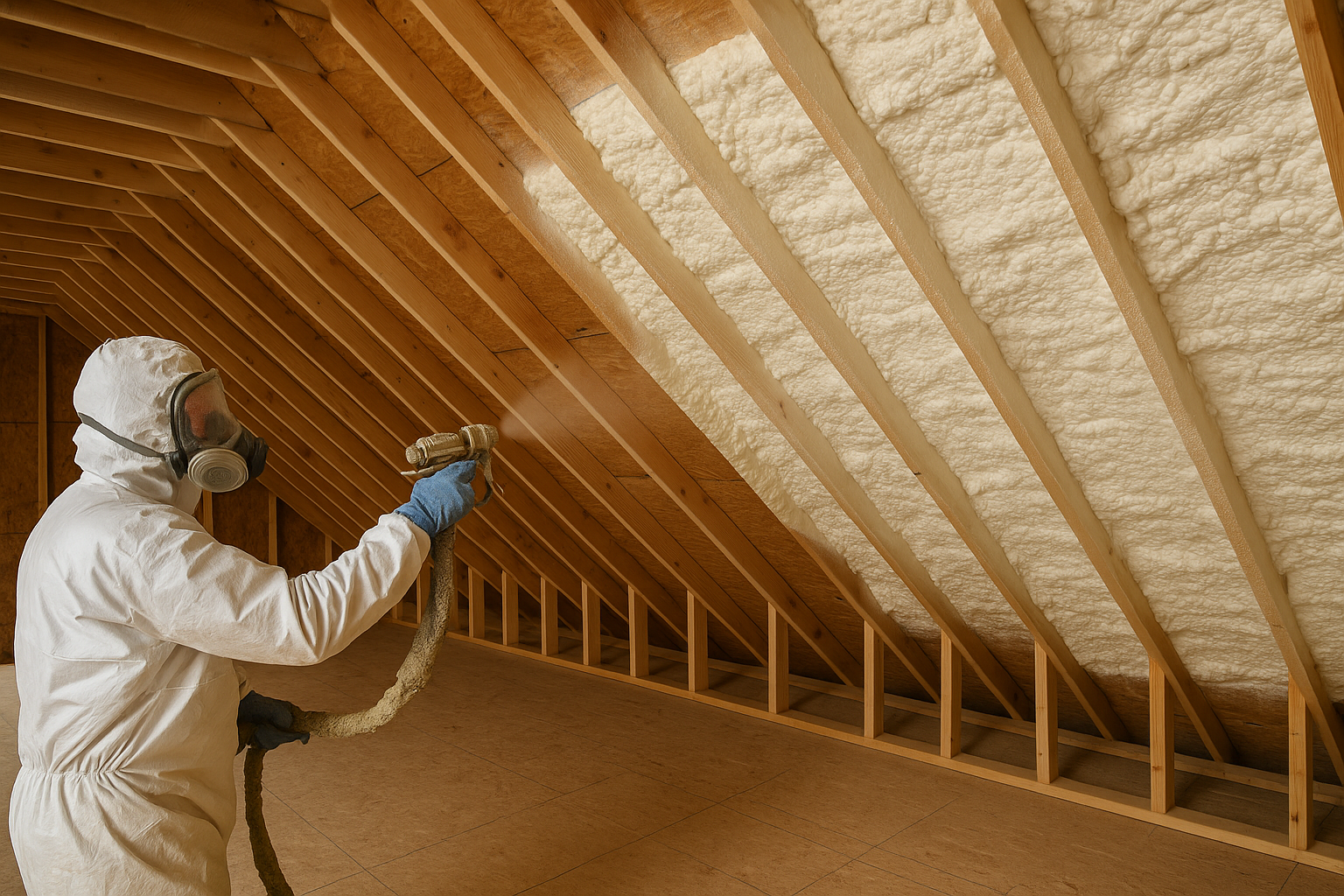
Spray foam insulation develops within enclosed building sections. The material begins as two liquid components. These components mix at the spray point. Expansion follows immediately. A solid structure forms after curing.
The foam remains fixed after placement. It adheres to surrounding materials. The surface appears continuous across the cavity.
Curing Reaction
Spray foam insulation undergoes a chemical reaction after mixing. The liquid expands as gas forms within the mass. This process continues for a short duration. The foam rises and spreads across the surface.
The reaction slows as the material stabilizes. The outer layer begins to firm first. Inner sections follow. The structure reaches a stable state after full curing.
The cured foam remains unchanged. It does not return to liquid form.
Surface Integration
Spray foam insulation bonds directly to adjacent materials. The liquid state allows contact with fine surface details. Expansion pushes material onto the substrate.
This contact creates a continuous interface. Small gaps between surfaces become filled. The foam connects across edges and joints.
The integrated surface remains intact after curing. Separation does not occur under normal conditions.
Edge and Joint Coverage
Spray foam insulation extends into corners and joints during expansion. The material moves outward from the spray point. It fills narrow intersections between structural members.
Edges become sealed as the foam expands. The transition between surfaces appears smooth. Joint lines remain covered with material.
This coverage reduces open paths within the assembly. The structure reflects a closed surface condition.
Resistance to Movement
Spray foam insulation remains stable after curing. The material does not shift within the cavity. External forces produce limited movement.
Closed-cell foam holds its shape under pressure. Open-cell foam compresses slightly. It returns to form after the force is removed.
The overall layer remains in position. Movement within the structure stays minimal.
Interaction with Light and Surface Finish
Spray foam insulation presents a textured surface after curing. The surface reflects the expansion pattern. Raised and uneven areas appear where the foam has grown.
The color remains consistent across the layer. Surface trimming may occur to align with structural edges. The material allows shaping after curing.
Exposed foam reflects its application pattern. Covered installations conceal this surface.
Placement in Building Sections
Spray foam insulation occupies wall cavities, roof assemblies, and floor spaces. The material conforms to each section’s shape. Irregular geometry does not restrict placement.
Foam fills large and small voids. It adheres to all sides of the cavity. Placement is consistent across different sections.
Each location reflects the same expansion behavior. The result appears uniform within the structure.
Conclusion
Spray foam insulation forms through a curing reaction that creates a stable internal structure. The material integrates with surrounding surfaces during expansion. It remains fixed after curing. The continuous layer defines its role within enclosed spaces.
Coverage across edges and joints reflects its ability to fill irregular areas. The surface retains the form created during expansion.
Isothane produces spray foam insulation systems with stable curing characteristics. Their materials reflect consistent surface integration and controlled expansion within building assemblies.
For more information, visit https://isothane.com/