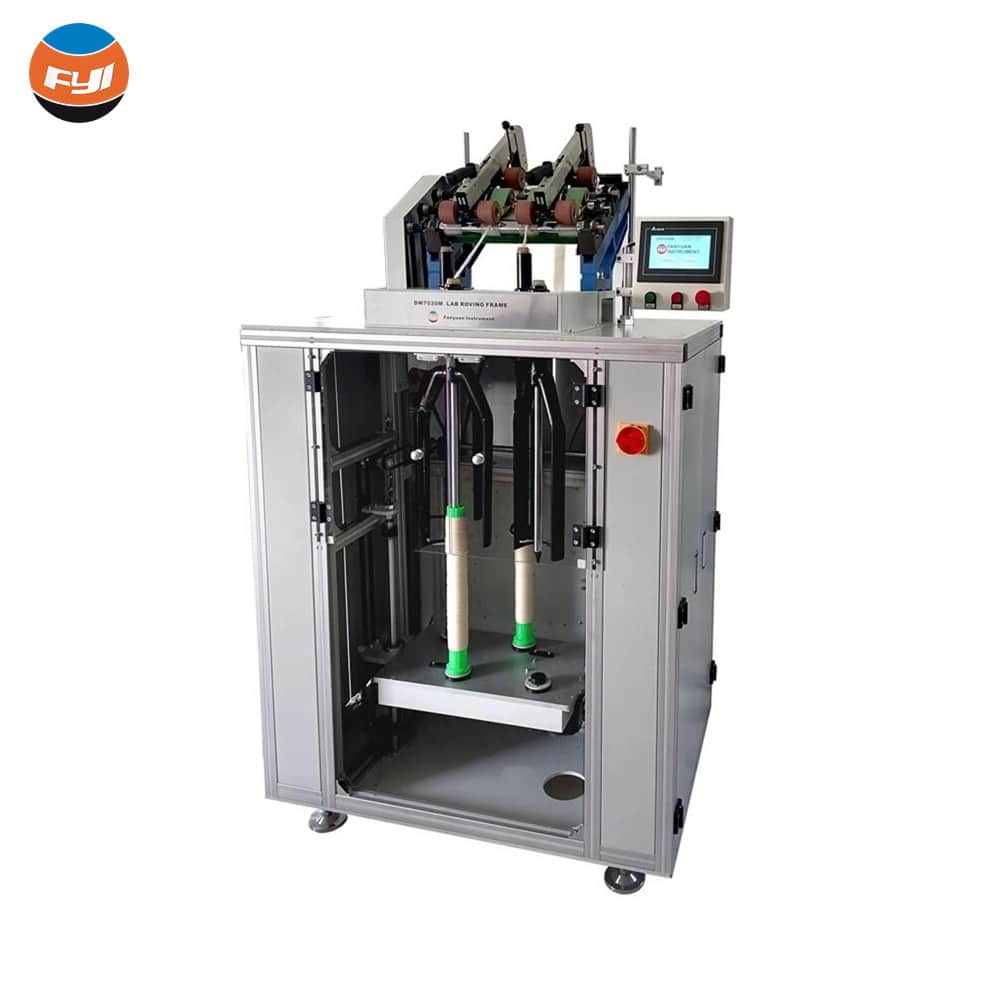
Lab Roving Machine is a specialized textile laboratory device used to prepare roving from fiber sliver for experimental and developmental purposes. Unlike industrial roving frames that focus on large-scale production, this machine is designed for controlled processing, making it suitable for fiber testing, yarn design, and academic research.
It allows textile professionals and students to analyze how different fibers behave during drafting and twisting. By producing uniform roving in small quantities, the machine helps laboratories study spinning performance without wasting large volumes of raw material.
Process Mechanism of a Lab Roving Machine
The operation of a lab roving machine is based on two main actions: drafting and twisting. Drafting reduces the thickness of the sliver and aligns the fibers, while twisting binds the fibers together to form roving.
The general working sequence is:
- Silver enters the drafting rollers
- Fibers are stretched and straightened
- Twist is added by the flyer and spindle
- Roving is wound onto a bobbin
This step-by-step process ensures consistent roving quality suitable for yarn trials.
Influence of Roving on Yarn Properties
Roving quality plays a major role in determining yarn performance. Poor roving can lead to:
- Frequent yarn breaks
- Irregular yarn structure
- Weak tensile strength
A lab roving machine enables operators to adjust machine settings and test different roving conditions. This makes it possible to:
- Improve yarn smoothness
- Enhance strength
- Reduce spinning defects
Thus, roving preparation becomes a key factor in yarn development.
Use in Fiber Comparison Studies
One of the most valuable uses of a lab roving machine is fiber evaluation. It allows researchers to compare:
- Different cotton varieties
- Wool grades
- Synthetic fibers
- Recycled fibers
By processing each fiber type under identical conditions, researchers can measure performance differences accurately and select the most suitable materials for production.
Machine Design That Enhances Precision
Modern lab roving machines are built with design features that improve accuracy and consistency:
Digital Parameter Setting
Draft and spindle speed can be set electronically to ensure repeatable test results.
Rigid Machine Structure
Strong frames reduce vibration and maintain stable roving formation.
Independent Drive Units
Separate drives for drafting and twisting ensure smooth mechanical coordination.
Optimized Fiber Path
Smooth fiber guides reduce friction and prevent fiber damage.
Compact Configuration
Small size allows installation in limited laboratory space.
Application in Wool Spinning Research
In wool spinning, fiber length and structure must be carefully maintained. Wool roving machines are designed to:
- Protect long fibers
- Avoid excessive tension
- Produce uniform wool roving
These machines are commonly used in textile research centers focused on worsted and specialty wool yarns.
Value for Training Institutions
Training laboratories benefit from lab roving machines because they allow students to:
- Observe drafting principles
- Understand twist control
- Learn bobbin formation
- Practice machine adjustments
This hands-on learning improves technical knowledge and prepares students for real spinning systems.
Energy Efficiency and Resource Saving
Compared to industrial roving frames, lab roving machines:
- Use less electrical power
- Require small fiber quantities
- Generate minimal waste
This makes them cost-effective tools for experimental and educational environments.
Maintenance and Operational Reliability
These machines are designed for daily laboratory use. Their structure allows:
- Easy access for cleaning
- Simple mechanical tuning
- Quick spare part replacement
As a result, laboratories can operate the machine continuously with minimal downtime.
Contribution to Industrial Innovation
Manufacturers use lab roving machines to test spinning conditions before full-scale production. This helps to:
- Detect spinning problems early
- Optimize roving parameters
- Improve yarn quality
- Reduce production risk
Such testing supports innovation in textile product development.
FAQs
Q1: Why is a Lab Roving Machine important in yarn development?
It allows controlled preparation of roving, which directly affects yarn strength and uniformity.
Q2: Can this machine be used for recycled fibers?
Yes, it can process recycled fibers for testing and performance evaluation.
Q3: Does it support wool spinning experiments?
Yes, wool-specific lab roving machines are designed for long fiber systems.
Q4: Is it suitable for research laboratories?
Yes, it is widely used in research centers and textile institutes.
Q5: Where can I find a professional Lab Roving Machine?
You can explore advanced models of the Lab Roving Machine here:
Lab Roving Machine